This post is not investment advice and not a buy or sell recommendation within the meaning of the German Securities Trading Act (WpHG) — it reflects my personal market observations and opinion only.
The author holds equity positions in lithium companies and is therefore not neutral. Investing in equities carries substantial risk up to and including total loss of the capital invested. Please do your own research or seek qualified advice.
Just as the last article opened with the CATL Jianxiawo mine, so does this one. Everything currently revolves around the question of whether we’re heading into a period of surplus or shortage of lithium carbonate. Under the classic “supply vs. demand = price” logic, one side looks at how many mines are running and coming online soon (supply), while the other side (demand) tracks how many batteries for EVs and BESS are being produced and how fast those two segments grow. For the lithium price and for equities, it is not only the actual current deficit (or surplus) that matters, but also the future expectation of it. “The market trades the future” — as the saying goes. Which is why the futures contract deserves at least as much attention on your watchlist as the current lithium price itself.
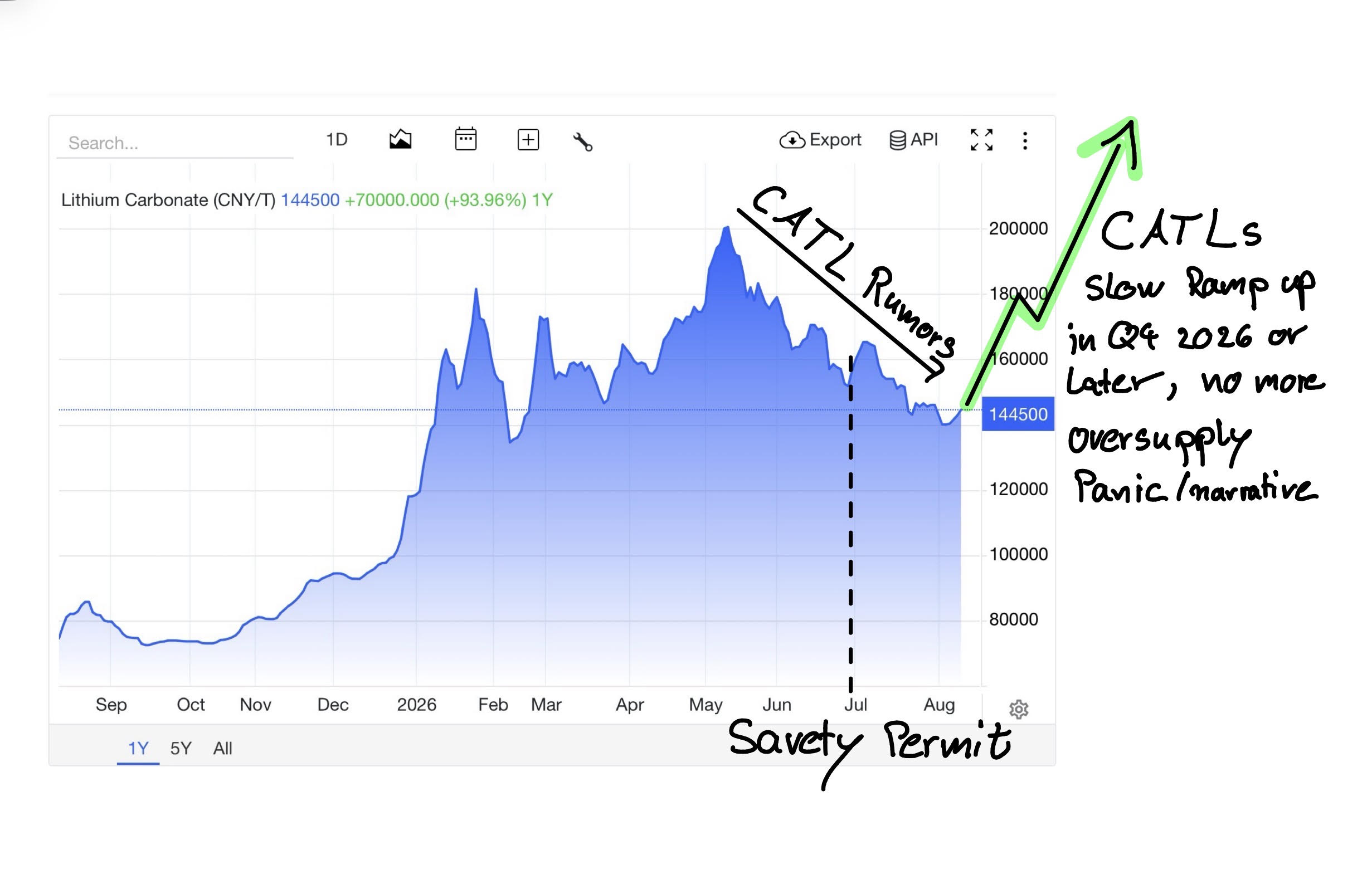
The CATL mine will not come online soon after all — that much is now clearer. The mine remains true to itself and the long round of speculation about exactly when it would tip the lithium market into oversupply and drag prices into the abyss (deliberately exaggerated wording, but that’s how it sometimes feels given the market reactions this mine can trigger) is over — for now. Reuters reported on 7 August 2026: CATL’s Jianxiawo lithium mine remains closed pending environmental approval, state media reports. Additional reports confirm that CATL has shut the mine down for maintenance work. That the mine needs time to ramp up before producing meaningful volumes — Chinese efficiency or not — was no secret, but the speculation about an imminent start following CATL’s safety approval at the end of June has now been debunked. Yet this is by no means a general cancellation or long-term delay. It is more of a confirmation that the mine is following its normal legal process before ramp-up begins. The Safety Production Permit (安全生产许可证) has been granted, the Environmental Impact Assessment (环评 / EIA) is still pending in the regular approval process; on 28 July there was an Environmental Impact Report that entered the public consultation phase. No pre-work is currently being done at the mine — which, without environmental approval, could otherwise trigger penalties. A start in Q4 is still needed. So in summary: speculation about a quick commissioning of the CATL mine has now officially been refuted. It will take a few more weeks to months before initial work at the mine begins. Or, as YJLee put it on X in his own words: CATL gifted itself a nice discount through the speculation around its mine opening.
Market development over the past months
Around mid-May, the lithium price and futures hit their highs at over 200,000 CNY/t LCE. From there the price fell to ~135,000–140,000 CNY/t LCE by early August — roughly –30%. Yet one can argue that this price has still nearly doubled since August 2025 (~72,000) and remains clearly in the plus year-to-date (from ~120,000). While the price fell by roughly 30%, many lithium stocks fared far worse. The Chinese with GANFENG (~–50%) and TIANQI (–48%) roughly halved, Australians with Pilbara Minerals (–40%), IGO (–35%), Mineral Resources (–30%) held up comparatively well, though Liontown (–62%) clearly stands apart, while South American names such as Albemarle (–46%), SQM (–30%), Lithium Argentina (–53%), Galan Lithium (–51%) and Sigma Lithium (–57%) posted partly much steeper drops from their yearly highs. Comparing the different declines, company-specific factors play a big role too. Liontown achieved lower realised prices than its peers and battles higher costs, while Sigma has issues with the local environmental agency. Uncertain producers who don’t yet benefit from the generally attractive lithium price took the deepest hits. In some cases stocks such as Lithium Americas even trade at the same level as they did a year ago at half the lithium price — despite the project being further along the path to production than many newcomers. Overall, many equities have fallen far more sharply than the lithium price itself, and it looks like an overreaction to the downside. Because the current 140,000 CNY / USD 20,000 level is by no means dramatic for producers. Even the most expensive producers earn healthy margins at this price, even if one can debate whether the level offers enough incentive for future new projects. My interim verdict: many stocks have overshot to the downside; a drop to 140,000 CNY alone cannot justify these declines. Low-cost producers generate very solid cash flows here and many should end up on single-digit P/E ratios.
Where does the price go from here?
No one can say with certainty. But there are a number of factors worth looking at more closely for guidance.
-
The chart technicals — according to chart expert Carl Capolingua — were already very negative. A critical demand zone at ~143,000 was broken and in his chart images the trend channel turned reddish. But repeated counter-moves appeared as well. The (so-far) low (below the critical zone) was then found at 137.76 CNY on 31 July. While the lithium price kept sinking week after week, there were also more optimistic reports — the situation improved thanks to the very bullish CATL report, and other data such as low inventories and solid corporate earnings stood in stark contrast to the weak stock- and lithium-price action.
-
CATL H1 report 2026 CATL’s H1 report paints a very strong picture for battery-system demand. CATL produces at nearly full utilisation of 95% — 498 GWh. Their current production capacity of 525 GWh is set to be expanded in the coming years by the 764 GWh currently under construction — more than doubling capacity. Notable: the EV share is 70% of total revenue, energy-storage systems are close to 19% — but the latter grows strongly at +87% YoY (EVs only +45% YoY). Their global market share in drivetrain batteries stands at 40%. When the world market leader invests in expansion of this magnitude, that is a strong indicator of growth in this segment. The resulting lithium demand is obvious. Additionally CATL is very optimistic in its outlook. Demand is robust and strong, they don’t know where rumours of weakening demand come from, and so on.
-
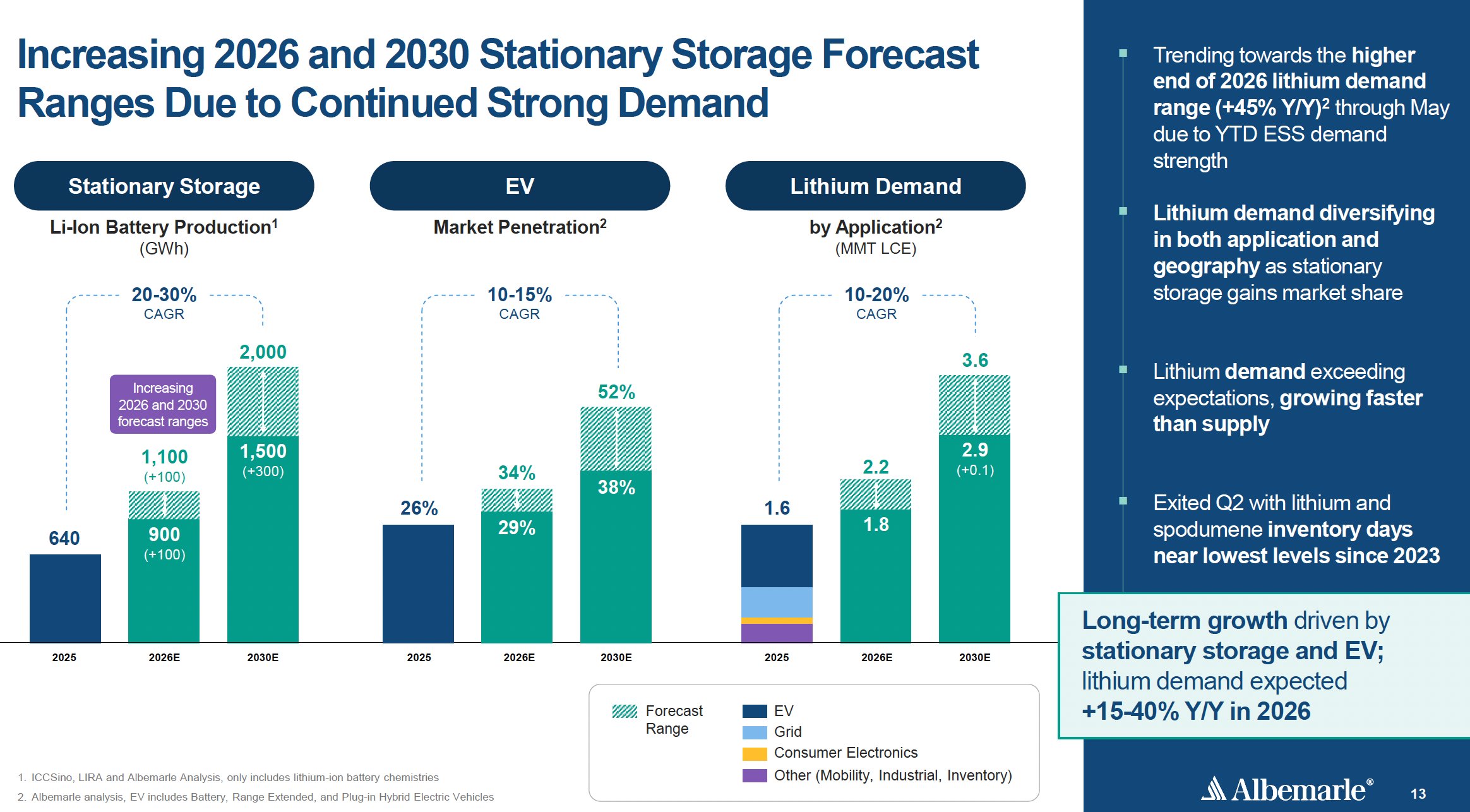
Albemarle Q2 numbers Albemarle’s Q2 numbers support the trends from the CATL report. Lithium demand is rising faster than supply, inventories at their lowest levels since 2023, lithium demand in May +45% YoY and long-term demand growth through 2030 of 10–20% — from 1.6 MMT LCE to 2.9–3.6 MMT LCE.
-
Inventories Inventories have hit a multi-year low.
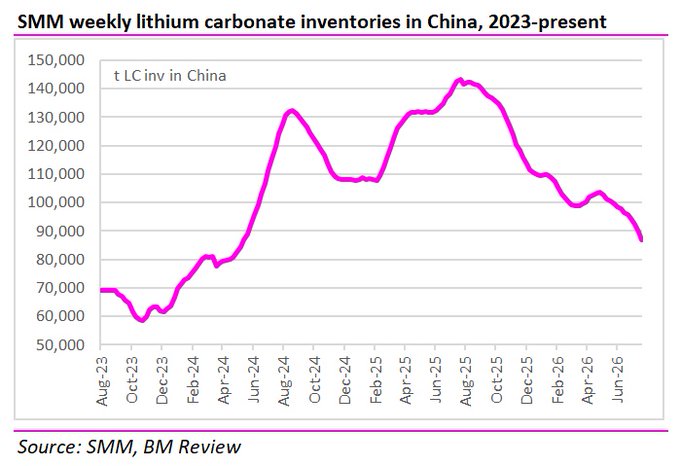 So, rather than restocking lithium, producers have drawn on their own inventories. This reduces demand — but it cannot continue indefinitely. Once the warehouses are empty their drawdown can no longer suppress demand; if producers additionally start rebuilding inventories, that adds to demand; and if actual production is being ramped up — as is the case at many downstream producers — that boosts demand further.
There are reports in Chinese media about the reasons why downstream players are currently hesitant to refill stocks. On the one hand it is a power struggle over the price. If demand falls due to inventory drawdowns, the price falls too and one can buy lithium carbonate more cheaply in the future. So producers are speculating that they will be able to buy more cheaply later. They are also afraid of being stuck with too high purchase prices and building losses in their inventories — as was the case at the last lithium peak and the subsequent sharp collapse.
A small damper on BESS growth comes from the China National Energy Administration in its H1 2026 report. The following additions of battery systems on the grid can be derived from it. Half-year, Net addition, Cumulative at end: H1 2025, +21 GW, ~95 GW H2 2025, +41 GW, 136 GW H1 2026, +17 GW, 153 GW H2 2026, still ongoing, — H1 2026 was therefore a 19% decline compared with H1 2025 — and a downright 58.5% collapse compared with H2 2025. This development can be partly explained by expiring incentives and regulatory transition rules. Many projects were pulled forward into H2 2025 to still benefit from the old pricing and subsidy conditions. As a result H1 2026 fell noticeably weaker. Still, not a pretty trend — it puts the growth path somewhat into question. H2 2026 will be interesting. And if CATL is to be believed, the trend should soon strengthen again.
Verdict and personal take
There is no single factor you can look at to reliably estimate where the price will run. It is a complex global market with countless drivers. Whether there is a surplus or deficit is not easy to calculate for the present, nor to forecast for the future. Nonetheless, much points to an enormously rising demand that will be very difficult to satisfy. Experience shows how many years projects need before producing their first tonnes. I believe the current data points to another bullish cycle.
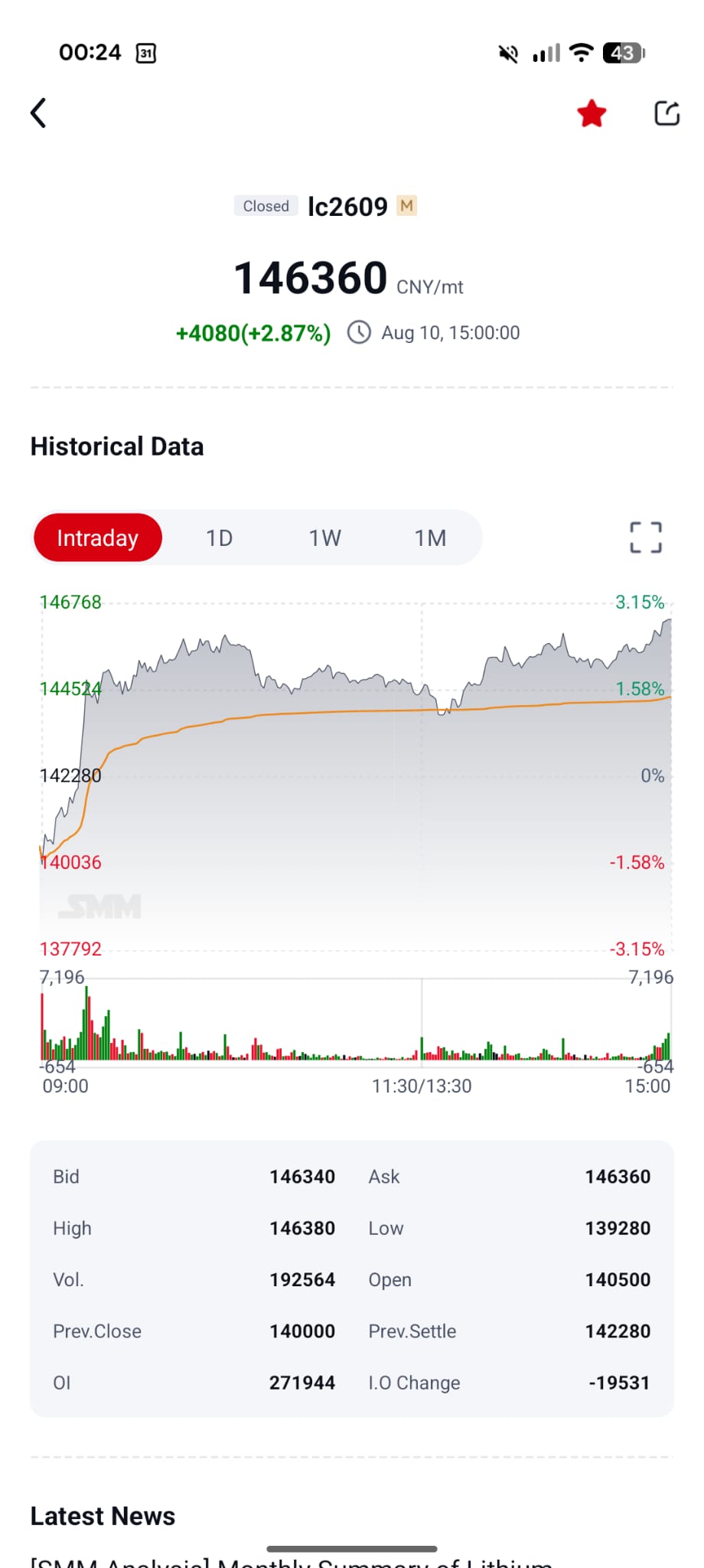
The futures reacted to the CATL mine shutdown on Monday, 11 August 2026, with a gain of nearly +4.5%. The news actually came out last Friday, but perhaps only after market close.
Equities
Many stocks are back at very attractive levels and the risk-reward profile is very good — especially for projects that (1) are low-cost and (2) already produce or are close to it. Above all this includes Lithium Argentina $LAR, Sigma Lithium $SGML, Galan Lithium $GLN. With Sigma the caveat is that this Friday, 14 August, positive news should arrive regarding a settlement (TAC agreement) with the environmental agency of Minas Gerais — on which it depends whether they can finally run at nameplate capacity after a rocky last half-year. More info here. Otherwise larger companies such as Albemarle $ALB, Ganfeng $GNENF, Zijin Mining $2899.HK are good touchpoints.